
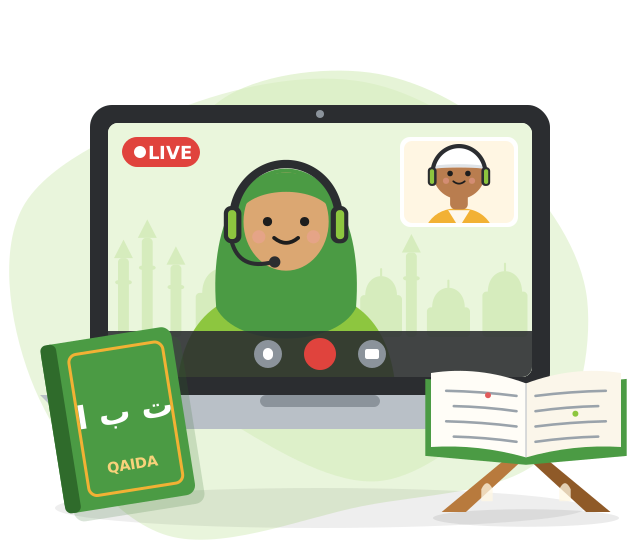
Here is how to learn Quran online step by step. First, decide what you want to learn. Then find your starting level and set up a simple class at home. After that, it is a few short classes a week and ten minutes of practice a day. This plan works for a child of 5 and for an adult of 50.
Many guides start with the Arabic alphabet. But not everyone needs to start there. Some people already read a little. Some want to memorize. Some want to know what the words mean. So this guide starts with your goal, not with the first letter.
If you just want a teacher to tell you where to begin, our online Quran classes for beginners start with a free level check.
How to Learn Quran Online Step by Step: The Short Version
Here are the 7 steps on one screen. Each one has its own part below.
- Step 1: Decide what you want to learn.
- Step 2: Find your starting level.
- Step 3: Choose a live teacher, an app, or both.
- Step 4: Set up your device and a quiet corner.
- Step 5: Choose how many classes a week.
- Step 6: Take a trial class and watch for a few signs.
- Step 7: Practise 10 minutes a day between classes.
Step 1: Decide What You Want to Learn
People say they want to learn Quran online. But that can mean many things. Your goal picks your course. Find the line below that sounds most like you.
Not sure which one fits? That is fine. Most people start with reading, because every other goal needs it. You can see all our options side by side on the Quran courses page.
- I want to read the Quran, even a little, for my prayers: start with Noorani Qaida (the first book for Arabic letters). It takes most people 3 to 6 months.
- I can read, but I am not sure I read it right: take Quran Reading with Tajweed (the rules for saying each sound correctly). Most take 6 to 12 months at 3 classes a week.
- I want to learn the Quran by heart: choose Hifz (memorizing). It starts from age 7, once you read well. The whole Quran takes about 3 years with daily classes.
- I want to know what the verses mean: choose Tafsir (the meaning and explanation of the Quran), for ages 12 and up. Or learn Arabic, which takes 6 to 18 months.
- I am a new Muslim: take Prayer Lessons (1 to 3 months) next to Noorani Qaida. Your tutor can split the class time, so both move forward. Our guide for new Muslims explains the first steps.
Step 2: Find Your Starting Level
Next, be honest about where you are today. There is no shame in any level. Many adults who grew up Muslim never learned the letters. Others read well but never had a teacher check them.
You do not need to test yourself alone. In a trial class, the tutor listens to you read for a few minutes and tells you your level. But this quick check helps you know what to expect.
- I cannot read Arabic letters yet: you start at the first page of the Qaida.
- I know the letters but read slowly, sound by sound: your tutor may move you quickly through the early Qaida lessons.
- I read smoothly, but no one has checked my Tajweed: you start in the Quran itself, with a tutor fixing each rule.
- I read well with Tajweed: you can go straight to your goal, such as Hifz or Tafsir.
Step 3: Live Teacher, App or Both?
Apps and videos are useful. You can listen to a good reciter on the bus, learn letter shapes on a phone, and repeat a sound as often as you like. This costs little or nothing.
But an app cannot hear you. For centuries, the Quran has been passed on this way: a student reads to a teacher who listens and corrects. Small mistakes in a sound can change a word. If no one catches them, they become habits that are hard to undo.
So the best way to learn Quran online is often both. A live teacher hears you and corrects you a few times a week. An app or a recording helps you listen and practise on the other days. If you can only choose one, choose the teacher.
Step 4: Set Up Your Device and a Quiet Corner
What do you need to learn Quran online? Less than you think. You do not need to buy books. The tutor shows each page on the screen.
Pick a spot away from the TV and the kitchen. Use the same spot each time, so your mind knows it is Quran time. For young children, sit close by for the first few classes. Keep your camera on, so the tutor can see how you shape each sound.
- A laptop, tablet or phone. A bigger screen makes the letters easier to see.
- A camera and a microphone. Most devices have both built in.
- Steady internet and Zoom or Google Meet. Both are free to use.
- Headphones, if your home is busy. They help you hear small differences in sounds.
Step 5: Choose How Many Classes a Week
Each class at Salam Campus is 30 minutes, live and one-on-one. So the real question is how many short classes fit your week. Here is the simple maths.
More classes mean faster progress, but only if you can keep them up. A plan you keep for a year beats a fast plan you drop in a month. Most beginners choose 3 a week. You can change the plan with 1 week's notice. See every plan in your currency on our Quran learning fees page.
- 2 classes a week: 1 hour a week. Good for ages 4 to 6, or a very busy adult. USD 40 a month.
- 3 classes a week: 1 and a half hours a week. Our standard plan for Qaida and Tajweed. USD 54 a month.
- 4 classes a week: 2 hours a week. Faster steady progress. USD 71 a month.
- 5 classes a week: 2 and a half hours a week. Fast reading, or getting ready for Hifz. USD 88 a month.
Step 6: Take a Trial Class and Watch for These Signs
Never pay for months of classes before you meet the teacher. A trial class shows you more than any website can. At Salam Campus, the trial is a full 30-minute lesson, and we do not ask for card details. You can book a free trial and see how it feels before you decide anything.
During the trial, watch the teacher more than the platform. These are good signs. For a longer checklist, read our guide on how to choose an online Quran teacher.
- The teacher asks you or your child to read, and really listens.
- Mistakes are fixed gently, right away, with a clear reason.
- The teacher talks to you in a language you understand.
- At the end, you get a clear plan: which course, how many classes and what it costs.
Step 7: Practise 10 Minutes a Day Between Classes
Class time is where you learn. Home time is where it sticks. Ten minutes a day does more than one long hour on the weekend.
Keep it simple. Read the line your tutor gave you, out loud, a few times. Point at each letter, so you read the page and not your memory. Go back to one sound that felt hard. Then stop while it still feels good.
Tie it to something you already do every day. After Fajr (the dawn prayer) works well for many adults. For children, after school or before bed works well. Parents do not need to read Arabic to help. Just sit with your child and listen.
Your First 90 Days: What Progress Looks Like
Most people want to know what they will be able to do after 3 months. Here is a rough picture for an adult beginner on 3 classes a week, with 10 minutes of practice a day.
Children move more slowly, and that is normal. Most children finish the Qaida in 4 to 6 months, while most adults finish in about 3. Your tutor gives you a real estimate after the first 2 or 3 lessons. Then you will know your own pace, not just an average.
- Month 1: you know the letters and their sounds. You can tell apart letters that look alike. You start to see how letters change shape when they join.
- Month 2: you read short words with vowel marks. You learn long sounds and doubled letters. Reading is slow, but it is real reading.
- Month 3: you meet beginner rules, such as noon sakinah. You read short surahs from the last juz (1 of the 30 parts of the Quran). Many adults finish the Qaida around now.
- After that: you move into the Quran itself with Tajweed. Each week, you read with fewer stops.
Mistakes That Slow Online Learners Down
Most people who stop do not stop because it is hard. They stop because of a few small habits. Watch out for these.
- Reading from transliteration (Arabic written in English letters). It feels faster, but it hides the real sounds. Learn the Arabic letters instead.
- Skipping the basics. If you rush the Qaida, the same mistakes show up later in every page of the Quran.
- Picking a plan that is too big. Five classes a week sounds keen. But if you miss half of them, three would have been better.
- Missing classes without telling the teacher. Tell us before a class, and we move it to another time in the same month.
- Practising only on class days. The 10 minutes on the other days is what makes progress feel easy.
- Changing courses or teachers every few weeks. Give one plan at least a month before you judge it.
Ready to Take Step 1?
You now know how to learn the Quran online: pick a goal, find your level, set up a quiet corner, choose a plan you can keep, test the teacher, and practise a little each day. None of these steps is hard on its own. The hard part is starting.
If you want to begin today, learn Quran online with Salam Campus. Our tutors teach children from age 4, adults and new Muslims, with male and female teachers in your own time zone. Your first lesson is free. Book your free trial class, and your tutor will help you with steps 1 and 2.