
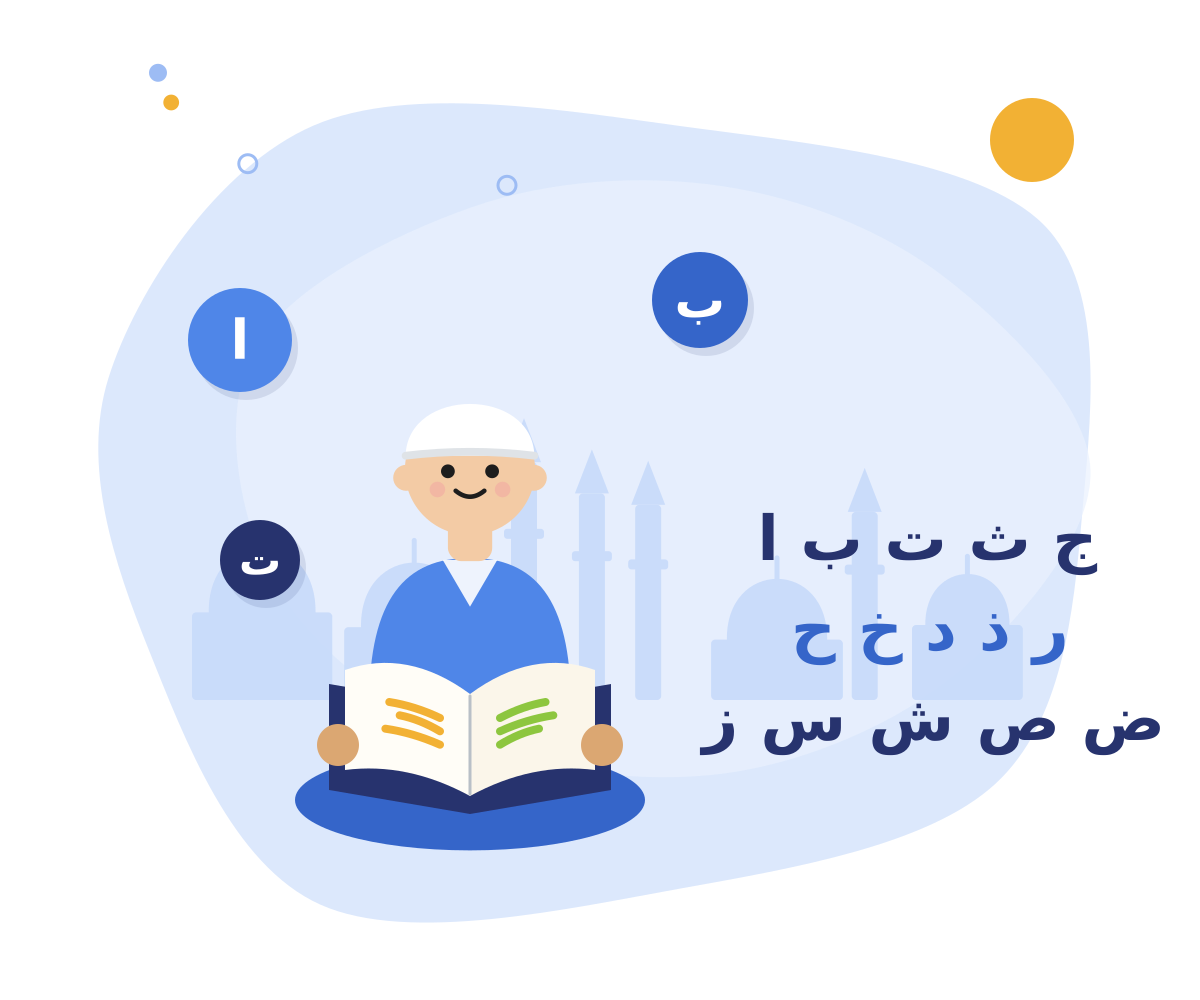
Many adults carry a quiet worry. They pray. They fast. They know a few surahs by heart. But they cannot open the Quran and read it from the page. If that is you, you are not alone, and you are not too late.
This guide shows how to learn to read the Quran as an adult, step by step, even from zero. We cover the letters, the vowels and the short surahs. We also give an honest timeline and a weekly plan that fits a busy life. If you would like a teacher on the way, see our online Quran classes for adults.
It Is Not Too Late: What Adults Do Better Than Kids
Is it too late to learn the Quran? No. Many of the Companions (the first Muslims) accepted Islam as adults, and they learned the Quran then.
There is also a hadith (a saying of the Prophet, peace be upon him) that speaks to every adult beginner. He said that a person who reads the Quran well will be with the noble and righteous angels. And a person who reads it with difficulty, stumbling over the words, gets two rewards. (Sahih al-Bukhari 4937, Sahih Muslim 798.) So the struggle itself is rewarded. You do not have to be fluent to earn good from it.
Adults also have real strengths that children do not:
- You know why you are learning, so you keep going on hard days.
- You can ask questions and understand the answers.
- You can plan your own practice time.
- You may already know some surahs by heart, which helps you check yourself.
Why Shyness Should Not Stop You
Many adults feel shy about reading like a beginner. That feeling is normal. It is also the main reason people put off starting for years.
A private, one-on-one class removes most of it. There is no group and no one to compare yourself with. Only your teacher hears you, and your teacher has heard every mistake before. Their job is simply to fix it and move on.
Why Reading from English Letters Holds You Back
Some adults read the Quran from transliteration (Arabic words written in English letters). It feels like a shortcut. But it holds you back in 3 ways.
- Some Arabic sounds do not exist in English. For example, English writes 'h' for both the soft letter haa and the deeper letter Haa. They are different letters, and they can change a word's meaning.
- Long and short vowels often look the same in English letters. So you may stretch the wrong sound, or not stretch the right one.
- You stay tied to special books and apps. You cannot open a normal mushaf (printed copy of the Quran) at the mosque and read.
How to Read Quran Without Transliteration
If you use transliteration now, you do not need to drop it today. Lean on it for a few weeks while you learn the letters. Then put it on the shelf. The sooner your eyes read the Arabic script, the sooner it feels natural.
Step 1: The Arabic Letters and Their Sounds
Start with the 28 letters of the Arabic alphabet. Arabic is read from right to left. Many letters share one shape and differ only in their dots. For example, baa, taa and thaa look the same except for the dots.
Some sounds will be new to an English speaker. The letters 'ayn, Haa, khaa and qaaf come from the throat or the back of the mouth. Learn each one with your ears, not just your eyes. A teacher or a trusted recording of the Qaida helps here.
Most adults start with Noorani Qaida (the first book for reading Arabic letters). Learn a few letters each day, and say each one out loud. Do not rush this step. Firm letters make every later step faster.
Step 2: Vowels, Joining Letters and Short Words
Next come the 3 short vowels (harakat). Fatha gives an 'a' sound, kasra an 'i' sound and damma a 'u' sound. With these, single letters turn into sounds you can read.
Then you learn how letters join. Most letters change shape at the start, middle and end of a word. Six letters never join to the letter after them: alif, daal, dhaal, raa, zaay and waaw. Knowing this makes words much easier to break apart.
After that, you meet a few more marks. Madd means stretching a sound. Tanween is the double vowel at the end of a word, which adds a soft 'n' sound. Sukoon shows a letter with no vowel. Shaddah shows a doubled letter. Practice short words of 2 or 3 letters until they feel easy.
Step 3: Short Surahs You Already Say in Prayer
Now turn to the surahs (chapters) you already know by heart. Good ones to start with are Al-Fatihah (1), Al-Kawthar (108), Al-Ikhlas (112), Al-Falaq (113) and An-Nas (114). Most of these are in the last juz (the 30th of the Quran's 30 parts).
You already know the sound. Now you match each word on the page to it. Read slowly with a finger under each word. Be careful: memory can hide small mistakes. This is where a teacher listening to you helps the most.
In the Quran (54:17), Allah says that He has made the Quran easy to remember, and asks if anyone will take the lesson. Many learners find comfort in this verse when a page feels hard.
How to Learn to Read the Quran as an Adult with a Busy Week
You do not need hours a day. Most adults at Salam Campus choose 3 private classes a week, each 30 minutes long. Add about 10 minutes of practice on most other days, and you have a plan.
At that pace, the Qaida stage usually takes about 3 to 4 months. Reading the Quran slowly with correct letters usually takes 4 to 6 months from zero. Smooth reading with full Tajweed (the rules for saying each sound correctly) takes about a year of regular classes. If you can already read a little, you will move faster. For more detail, see how long it takes to learn Noorani Qaida.
Here is a sample week:
- Monday, Wednesday and Friday: a 30-minute class before work or after the children sleep.
- Tuesday, Thursday and Saturday: 10 minutes of reading the homework line out loud.
- Sunday: a short review of the week, or a day of rest.
Times and Fees for Working Adults
Many adults study early in the morning or late in the evening. Others study at weekends, which cost the same as weekdays. If work gets in the way, tell us before the class and we will move it.
Three classes a week cost USD 54 a month (GBP 42, CAD 72 or AUD 66). There is no sign-up fee, and you can pause with 1 week's notice. See all plans on the fees page. Not sure where to begin? A free trial class is a real 30-minute lesson. The tutor checks your level and suggests a plan. No card is needed.
Self-Study, Apps or a Live Teacher: An Honest Look
Each way of learning has a place. Here is a fair look at all three:
- Self-study with a book or free videos: free and flexible. But no one hears you, so wrong sounds can become habits.
- Apps: good for learning letter shapes and for daily review on your phone. But an app may not catch the small sound mistakes a trained ear will hear.
- A live teacher: hears every letter and fixes it on the spot. It costs money and needs a fixed time each week.
Mixing Methods That Work
Many adults mix them. They use a live teacher for sound and a PDF or app for short daily review. That way, practice is easy, and mistakes still get caught early.
Want a teacher of your own gender? Sisters can ask for a female Quran teacher, and classes with the camera off are fine. Brothers can ask for a male tutor. You can also change your teacher for free if the first match does not feel right.
Your first step can be small. Book a free trial lesson, read your first letters with a patient tutor, and see how it feels. You may be reading short surahs from the page sooner than you think.