
Skip to content
Salam Campus

Learn Quranic Arabic Online

Go from the first letter to reading the Quran with understanding. Our live one-on-one Arabic classes are taught by native teachers from Egypt and Jordan. They are made for students of all ages who did not grow up speaking Arabic.

Free first class · No card needed · No contract

Learn Quranic Arabic Online

Level

Beginner to Advanced

Typical Duration

6 to 18 months

Suitable For

All ages

Class Length

30 minutes

Teachers

Male and female

Learn Quranic Arabic Online with Native Arab Teachers

Arabic is the key to the Quran and the Hadith (the sayings of the Prophet). When you know the language, you read a verse and hear its meaning at once. You do not have to wait for a translation. Arabic is also a living language. People speak it in more than 20 countries. So the same skills help you in travel, at work and in your community.

When you learn Quranic Arabic online at Salam Campus, your teacher is a native speaker from Egypt or Jordan. Each teacher has taught students who are not Arabs for years. Classes are one-on-one and 30 minutes long. They follow a set series of textbooks, so each lesson builds on the one before. You will learn to read, write, understand and speak. The Quran stays at the heart of each lesson.
What You Will Learn

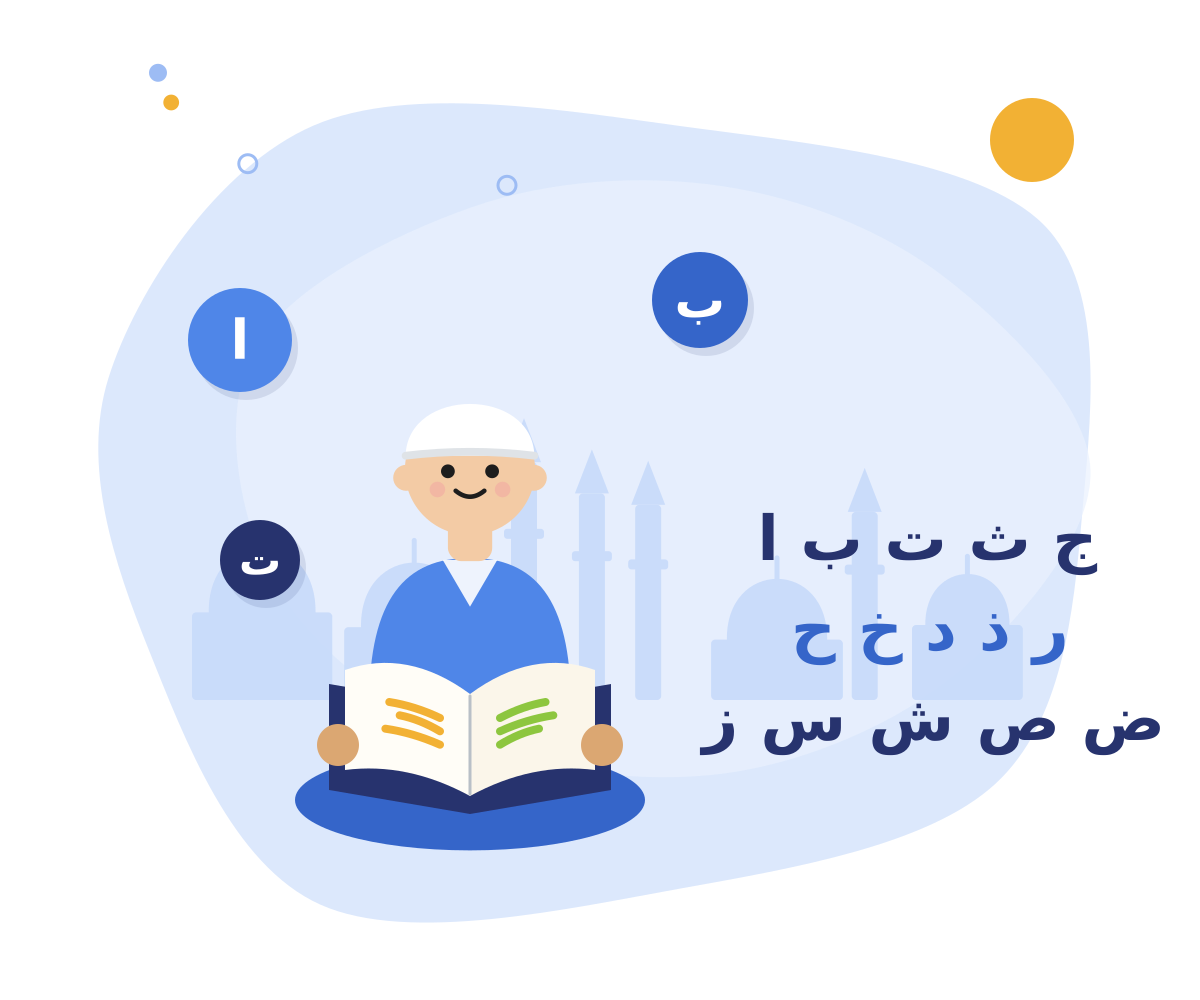
The course starts with the letters of the script. Then it moves on to grammar. Grammar helps you break a verse into parts and understand it. Speaking and listening practice runs next to this. This way, Arabic becomes a language you use. It does not stay a code you have to work out.

  • The letters, the vowels and how letters join
  • Reading and writing classical Arabic
  • The words used most often in the Quran
  • Nouns, verbs, male and female forms, number and sentence patterns
  • Changing verbs for past, present and different people
  • Numbers, days, times and daily phrases
  • Speaking and listening practice
  • Reading verses from the Mushaf (the written Quran) with understanding

Quranic Arabic Course Levels: From Letters to Grammar

The course has three levels. Here is what each level covers.

Beginner level: You start with the letters. You learn how each letter looks at the start, middle and end of a word. You also learn the short and long vowels. Within a few weeks, you read simple words and phrases. You also write them by hand. This stage is close to Noorani Qaida (the first book for reading Arabic). If you have already finished Qaida, you can skip ahead.

Intermediate level: You start learning grammar. The teacher uses words from the Quran where possible. So the words you practice are the words you will hear in Salah (the daily prayer). At this level, you learn:

Advanced level: You study verb forms, nouns made from verbs and if-then sentences. You also learn the styles of speech the Quran uses. You read longer passages of the Quran and simple classical texts with the teacher. Then you talk about the meaning in Arabic.

  • The two kinds of sentences: those that start with a noun and those that start with a verb
  • The three cases (the endings that show a word's job in a sentence)
  • The word al (the)
  • Pronouns joined to nouns and verbs
  • The past and the present tense

Which Arabic Books We Teach From

We use three well-known series of textbooks. The teacher picks one based on your age and your goal.

Al-Arabiyyah Bayna Yadayk has 3 volumes. It teaches Fus-ha (classical and standard Arabic). It builds grammar, sentences, writing and speaking at the same time. Most adults use this series.

Al-Arabiyyah lin-Nashi'een has 6 volumes and lots of exercises. It suits younger learners. It also suits anyone who wants extra practice in reading, writing, listening and speaking.

Durus al-Lughah al-Arabiyyah by Dr V. Abdur Rahim has 3 volumes. Many Islamic universities use it. It puts grammar first and works well with Quran study. So students who mainly want to understand the Quran often choose it. The teacher adds examples from the Quran to each lesson.

How Online Classes Work at Salam Campus

Book a free trial. We will then give you a native teacher. You can choose a male or female teacher. Your class is at a fixed time each week, in your own time zone. Classes run on Zoom or Google Meet with a shared screen. The teacher can show the textbook page, write on it and correct your handwriting as you go.

Each lesson has four parts:

Homework is short and useful. It might be a page of writing, a short reading or a voice note in Arabic. The teacher records your progress after each class. Parents of younger students get a summary each month.

Our timetable has mornings, evenings and weekends. It works for families in the USA, UK, Canada and Australia.

  • Reading
  • A short grammar point
  • New words to learn
  • A few minutes of talking in Arabic

Who This Course Is For

The course is open to all ages. Young children of 6 or 7 can join if they already know the letters. Adults can join even if they have not studied for many years. The course is made for people who did not grow up speaking Arabic, such as:

Complete beginners are welcome. If you cannot read the Arabic letters at all, the first few weeks teach you. Maybe you can read the Quran but do not know what it means. Then you can start straight at the grammar and word level.

Some children grow up with Arab parents in places like the UK or Canada. They understand a spoken dialect but cannot read or write. This course is a good fit for them too. The teacher uses the spoken Arabic they already know. From there, the teacher leads them into reading, writing and the classical Arabic of the Quran. This step is usually quick and very rewarding.

  • New Muslims who want to pray with understanding
  • Parents who want to help their children
  • Students getting ready for Islamic studies
  • Workers who need Arabic for their job or for travel

Learn Arabic Online for Non-Arabs

Outside the Arab world, good Arabic teaching is hard to find. Local classes often meet once a week in a group. You get little chance to speak. Online one-on-one lessons fix this. You talk with a native speaker in each class. You hear the right way to say each word from day one. You also get quick feedback on your reading and writing.

Our teachers know what is hard for learners who are not Arabs. Common problems include:

The teacher explains these points in English at the start. As your skill grows, the teacher slowly speaks more Arabic in class.

  • Letters that have no match in English
  • The root system, where most words are built from three letters
  • The way word endings change with their role in the sentence

Quranic Arabic Classes Online for Kids and Adults

Children learn through short, fun tasks. These include letter games, picture cards for new words, songs for numbers and days, and simple talks with the teacher. The teacher brings in grammar gently, through patterns instead of rules. Most children take two or three classes a week. The teacher reviews their progress with parents each month.

Adults move faster through the letters. They spend more time on grammar and Quran words. Many adults take this course together with our Tafsir (Quran explanation) classes. They use their new skills to follow the meaning of each verse in its own words.

Fees for Online Arabic Classes

Arabic classes use the same monthly plans as all our courses. The standard plan is three 30-minute classes a week. For students in the USA, it costs $54 a month. That gives you 12 lessons each month. You can also choose 2, 4 or 5 classes a week.

You can find prices for each plan in USD, GBP, CAD and AUD on our fees page at /quran-learning-fees/. There is no sign-up fee. We give you the textbooks as free PDFs. Your first lesson is a free trial.

Book a Free Trial

Learn Quranic Arabic and Understand What You Recite

The Quran uses a core set of a few thousand words. Just a few hundred of those words make up most of the text. So you learn those words first. You also learn the grammar that shows how words change. Then you start to grasp whole verses much sooner than you might think.

Students who reach the middle level often tell us that Salah feels new. They follow the Imam's recitation and understand it. They pay attention in a way a translation never allowed. That is the goal of this course. Our teachers keep this goal in mind from the first lesson to the last.

Try a free class. You risk nothing.

It is hard to choose a Quran teacher online. So we made the first step free. Every step after it is easy to undo.

Parents may join any class. You can listen in from the next chair.

Our promise to every family

  • The trial class is free. We never ask for card details to book it.
  • Not the right teacher? Ask us about a second trial with a different teacher.
  • No sign-up fee and no contract. You pay one month at a time.
  • Changed your mind? Ask within 7 days of paying. We refund every class you have not taken.
  • Pause or stop with 1 week's notice. You do not pay for paused weeks.
  • If your teacher misses a class, you get it back, or a cover teacher takes it. This is free.
  • Want a new teacher later? Just ask. We set up a trial with the new teacher within a week.
  • A female teacher or a weekend class costs the same.
  • Teaching more than one child? The second and third child pay a lower fee.

Frequently Asked Questions

No. Complete beginners learn the letters, the vowels and how letters join in the first few weeks. Have you already finished Noorani Qaida? Or can you read the Quran? Then tell us at the free trial. The teacher will start you at the reading or grammar level. You will not repeat the basics.

The course teaches Fus-ha. This is the classical and modern standard Arabic. It is used in the Quran, in books and in formal speech in all Arab lands. Your teacher will also teach common daily phrases. Then you can hold a simple conversation. But the base of the course is the Arabic of the Quran.

Adults usually use Al-Arabiyyah Bayna Yadayk or Durus al-Lughah al-Arabiyyah. Children use Al-Arabiyyah lin-Nashi'een. At the trial lesson, the teacher picks the series that fits your age and goal. We give you all books as PDFs. The teacher shares them on screen in class. So you do not need to buy anything.

Most students take three classes a week. After 6 months, they can read and understand short surahs with the teacher's help. After 12 to 18 months, they can follow longer passages. Your speed depends on how much you practice between lessons. Short, regular study at home makes a big difference.

Yes. Children from about 6 years old are welcome if they can sit for a 30-minute class. Lessons for children use games, pictures and simple talks. The teacher uses the Al-Arabiyyah lin-Nashi'een series. Parents get a progress summary each month. You can ask for a female teacher for your daughter.

Yes. Our teachers are native speakers from Egypt and Jordan. Each one holds a degree in Arabic or Islamic studies. They have taught many students who are not Arabs online. At the beginner level, they explain in English. As you progress, they switch more and more to Arabic.

Start Your Free Trial Today!

Meet a certified male or female tutor in a live 1-on-1 class. Pick a time that suits you. No card details are needed, and you do not have to sign up.

Book a Free Trial

Contact Us (24/7)

Message us on WhatsApp, email us or send the form. We will reply with a trial time within 24 hours.

WhatsAppFree Trial

Before you go: your first class is free