
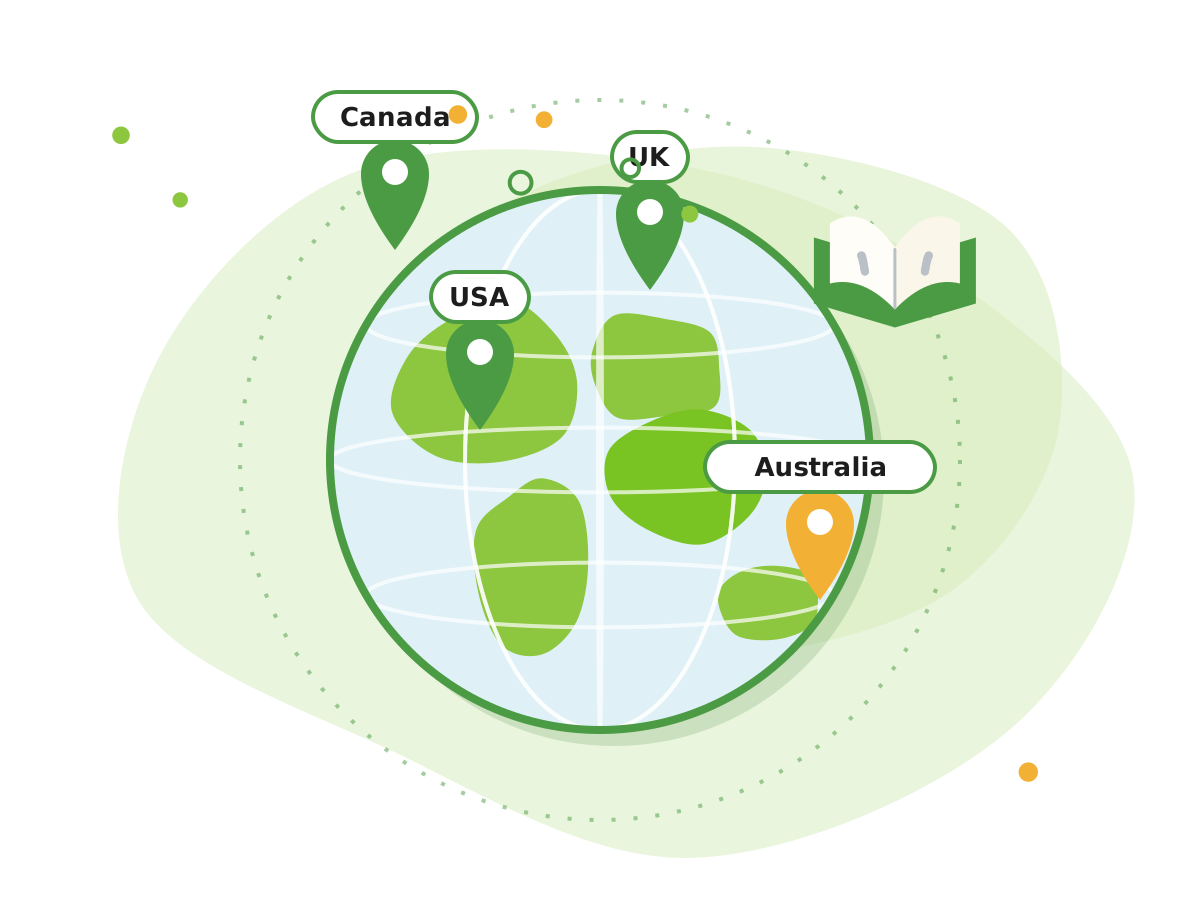
Your child will be on video with a teacher you have never met. It is fair to ask: are online Quran classes safe for kids? This page gives you a checklist to use with any academy, including ours.
We run an online Quran academy, so we are not a neutral voice. Where we have a written rule, we say so. Where we do not, we say that too. Test us with the same questions.
Save this page and use it before you book.
Are Online Quran Classes Safe for Kids?
They can be, when the academy has clear rules and a parent stays involved. No online class is safe by luck. Safety comes from a few simple things: a checked teacher, an open camera, a device in a shared room, a parent who can join, and an easy way to raise a worry. The checklist below tests each one.
A live 1-on-1 class is good for learning, because the teacher hears every word your child reads. But it also means one adult and one child on a screen. So the rules around the class matter as much as the teaching.
Talk often, stay close, and make it easy for your child to tell you.
12 Questions to Ask Any Online Quran Academy
Ask these by email or WhatsApp before you book, so you have the answers in writing. A good academy answers plainly and does not mind the questions:
- 1. Who runs the academy, and where? You should find a real address, an email and a phone or WhatsApp number. Teachers may live abroad, so ask where they are based.
- 2. How are teachers checked before they teach a child? Ask for the steps. Good answers name real checks, such as ID and paper checks, a test and an interview. "All our teachers are qualified" is not enough.
- 3. Do teachers have a police or background check? Ask which one. Rules differ from country to country. A clear "no" is more honest than a vague "yes", and then you can decide.
- 4. Can a parent join any class, without warning? The answer should be yes.
- 5. Who is on the call? You should see one teacher and your child, and nobody else. Is the teacher's camera on?
- 6. Are classes recorded? Some academies record and some do not. Both can be fine if they explain it. Ask who can watch the recordings and how long they are kept.
- 7. How does the teacher contact my child? Ask if teachers may send private messages to a child. A safe academy talks to the parent and uses its own channels.
- 8. Is there a written code of conduct for teachers? Ask to read it. It should say what a teacher may and may not do with a child.
- 9. Who do I tell if I am worried, and how fast will they reply? Someone other than the teacher should look into a complaint.
- 10. Can I change the teacher, for any reason, for free? You should not have to explain or argue.
- 11. What happens to my child's name and class data? Read the privacy policy, and check who the academy shares data with.
- 12. What are the refund rules, in writing? Be careful with any academy that wants full payment before you have seen a trial class.
A vague answer is an answer too. If an academy will not say who checks its teachers or who can watch recordings, think twice. For teaching quality, read how to choose an online Quran teacher.
Camera, Recording and Parent Rules for a Safe Class
Sit in on the first few classes. You will learn what a normal class feels like, so you can spot anything that is not. After that, join now and then, without warning.
Keep the device in a shared room, like the living room, not a bedroom with the door closed. Use a plain background, and hide any school name or home address.
The teacher's camera should be on, so you can see who is teaching.
A recording can protect your child. If you have a worry, someone can play the lesson back. But a recording also holds your child's face and voice. So ask who can watch it, and how long it is kept. An academy should never post recordings in public.
Watch for these signs in any class. If you see one, act as the last column says:
| What you notice | Why it matters | What to do |
|---|---|---|
| The teacher's camera is off or covered | You cannot see who is teaching | Ask them to turn it on. If they will not, end the class and tell the academy. |
| Someone else joins the call | A class should be one teacher and one child | Ask who it is. If the answer is not clear, end the call. |
| The teacher asks your child to move to a private chat or another app | It takes the child out of the academy's sight | Say no. Tell the academy at once. |
| The teacher asks for your address, your child's school or photos | A Quran lesson does not need any of these | Do not share them. Tell the academy. |
| The teacher asks your child to keep a secret from you | A teacher has no reason to keep secrets with a child | End the class. Tell the academy. If it feels serious, use the reporting links below. |
Online Safety Basics From Official Sources
Child safety groups and police agencies publish free advice for parents. We did not write it. Start with these:
- NSPCC (UK): Talking to your child about online safety. Pick a calm moment, ask open questions such as who they chat with, and keep the talks regular.
- CEOP Education (UK National Crime Agency): Advice for parents and carers. It covers grooming, parental controls and how to start hard talks. The old Thinkuknow web address now leads here.
- FBI (USA): Keeping kids safe online. Stay involved in your child's online life, and know the apps they use.
- U.S. Department of Justice: Prevention tips for parents. Keep devices in shared family spaces, check privacy settings, and teach children to tell a trusted adult about any odd request.
- eSafety Commissioner (Australia): Online safety basics. Ask often about their online life and who they talk to, and tell your child you will not take their device away if they tell you something feels wrong.
The advice is much the same everywhere. Talk often and stay calm. Tell your child they will not be in trouble if they speak up.
What to Do If Something Feels Wrong
If a teacher or any adult makes your child feel unsafe, take these steps in order:
- 1. If a child is in danger now, call your local emergency number first: 999 in the UK, 911 in the USA and Canada, or 000 in Australia.
- 2. Stay calm. Thank your child for telling you, and say they are not in trouble.
- 3. End the class or call. You do not need to wait for the academy to answer.
- 4. Keep any messages. Do not delete them, and take screenshots.
- 5. Tell the academy in writing. Say what happened, when it happened and who the teacher was.
- 6. Report online abuse of a child to an official body in your country. The table below lists them.
| Where you live | Official body |
|---|---|
| The UK | CEOP Safety Centre |
| The USA | CyberTipline |
| Canada | Cybertip.ca |
| Australia | eSafety Commissioner |
| Other countries | INHOPE |
What Salam Campus Does Today
This is not an outside opinion. It is what we have written on our own pages. Our page on how we keep children safe has the full detail:
- Who we are: Salam Campus has taught online since 2016. Our office is in Islamabad.
- Teacher checks: before their first class, every teacher passes a document check, a recitation test, a teaching test and an interview. Then comes a trial month: we review their classes every week, and only then do we confirm them as a teacher.
- Parent in charge: a parent books every child's classes. We talk to the parent about times, plans and progress, not to the child.
- Parent in the room: parents may join any class, with no need to tell us first. We ask families to use a shared room.
- Camera: each class has one teacher and one student, live on video. The teacher's camera is on.
- Recordings: we record classes. Only our quality team and coordinators can see them, and we never publish them. See our privacy policy.
- Progress: you get a short note after each class and a written report each month.
- Worries: email us, message us on WhatsApp or use the contact form, and write "Safeguarding concern" at the start. We reply within 1 working day. Someone other than the teacher looks into it, and you get a written answer within 5 working days.
- New teacher: ask at any time, for any reason, at no extra cost. We set up a trial within a week.
- Trial and refund: the first class is a free 30-minute trial, and no card is needed. Ask for a refund within 7 days of paying, and we refund every class you have not taken. See the refund policy.
A few answers are not on our website yet. These are how long we keep recordings, whether teachers give a police or character certificate, a written code of conduct for teachers, and a written rule on whether a teacher may message a child directly. If they matter to you, ask us before you book, and ask every other academy the same.
The most useful test is a real class. Book a free trial class, sit next to your child, and check each point on this page. To see who teaches, read how we hire and check our Quran teachers. Or read about our online Quran classes for kids.
Are Online Quran Classes Safe for Kids? Quick Recap
Online Quran classes are as safe as the rules around them. Ask the 12 questions. Use a shared room. Sit in at first. Know the warning signs, and know who to tell.
Most of all, make it easy for your child to speak up. Before the first class, tell them they can stop the class and come to you at any time.